Terrain-Specific Pressures: Sand, Mud, Rock, Gravel & Snow

Use this guide to set smart starting pressures for each surface, then fine-tune by rig weight and feel. Each section includes ranges, driving technique, failure modes, and quick field checks.
How to use this guide
- Start with the range for your terrain + rig weight (light <2.2t / medium 2.2–3.0t / heavy >3.0t).
- Drop in 2–3 PSI steps, drive 200–300 m, reassess steering feel, grip and sidewall bulge.
- Keep speeds low when aired down; reinflate for pavement and long hardpack transits.
Sand & Dunes (flotation first)
Soft sand demands a wide, gentle footprint so you ride on the surface. The goal is smooth, uninterrupted momentum.
| Rig weight | Typical PSI (all-terrain) | Notes |
|---|---|---|
| Light (<2.2t) | 12–16 PSI | Go lower in powder dunes; avoid sharp steering inputs. |
| Medium (2.2–3.0t) | 14–18 PSI | Use gentle throttle; plan run-ups, don’t dig. |
| Heavy (>3.0t) | 16–20 PSI | Watch sidewall heat; momentum > power; avoid sudden stops. |
Technique
- Stage run-ups straight; no sudden steering at crest.
- Commit to constant, light throttle; back out early if bogging.
- Use boards and a shovel before spinning.
Failure modes
- Wheelspin digs; avoid “roosting.”
- Over-steer at low PSI can roll a bead; slow steering at the top of dunes.
- Heat build-up on long beach transits — reinflate sooner.
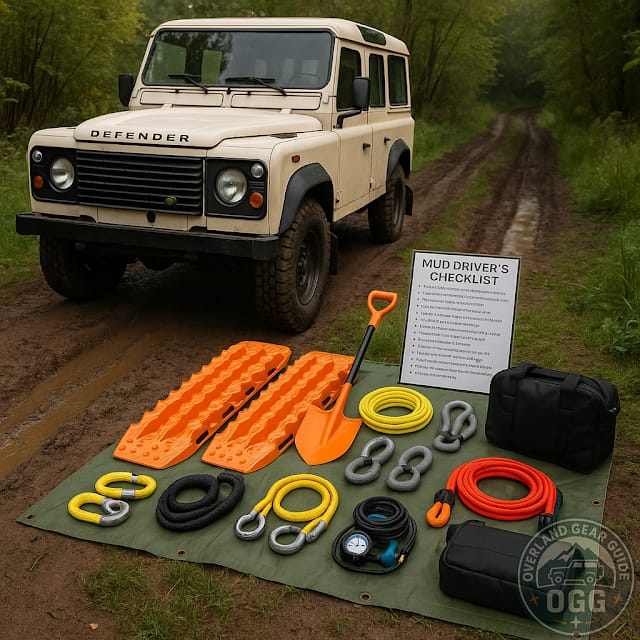
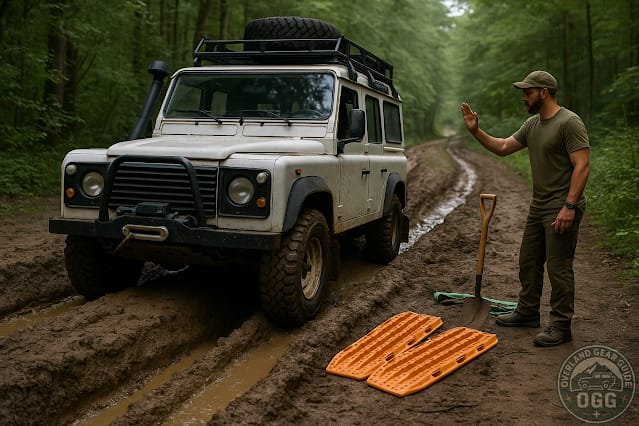
Mud & Clay (tread evacuation)
You want the tread to clear and bite, not skate on packed lugs. Too low can fold sidewalls and feel vague.
| Rig weight | Typical PSI (A/T or M/T) | Notes |
|---|---|---|
| Light | 16–22 PSI | Keep some firmness for shoulder support and steering. |
| Medium | 18–24 PSI | Clean lugs with measured wheel speed, not revs. |
| Heavy | 20–26 PSI | Balance bite with sidewall protection; avoid lateral ruts. |
Technique
- Choose the highest, firmest line; straddle ruts where possible.
- Use steady throttle; a brief “cleaning” spin only if needed.
- Boards + static strap for repositioning beats burying it.
Failure modes
- Low PSI + camber = sidewall pinch or de-bead.
- Stopping in suction pits — plan exit before entry.
- Unrated tow points in sticky pulls — don’t use tow balls.
Rocks & Ledges (deformation & protection)
Use lower pressures to wrap tread over edges and increase contact at crawl speeds. Protect sidewalls and rims.
| Rig weight | Typical PSI (LT A/T or M/T) | Notes |
|---|---|---|
| Light | 14–18 PSI | Spot carefully; place shoulders away from sharp edges. |
| Medium | 15–20 PSI | Slow steering; avoid side-loads on off-camber faces. |
| Heavy | 16–22 PSI | Consider beadlocks for frequent crawling; keep speed to a walk. |
Technique
- Creep with smooth throttle; let tyres conform.
- Use a spotter; protect sidewalls from slicing rocks.
- Reset if scraping diffs repeatedly; build a small ramp.
Failure modes
- Rim strikes from speed — keep it crawl-pace.
- Bead unseating from lateral shock.
- Sidewall cuts on turned front tyres against rock.
Gravel & Corrugations (damping washboard)
A small reduction improves comfort and control by adding compliance, but watch heat and speed.
| Rig weight | Typical PSI (A/T) | Notes |
|---|---|---|
| Light | 24–30 PSI | Short sections only at moderate speeds. |
| Medium | 26–32 PSI | Mind tyre temps; extend sidewall life. |
| Heavy | 28–36 PSI | Err higher when loaded; reinflate for long transits. |
Technique
- Keep speeds conservative; don’t “skip” over corrugations.
- Brake early; loose marbles increase stopping distance.
- Check temps at breaks; hot sidewalls = reinflate.
Failure modes
- Heat build-up from extended speed at low PSI.
- Shoulder wear from long gravel miles underinflated.
- Hidden washouts — eyes up, scan further.
Snow & Ice (footprint + finesse)
Cold temps reduce pressure; aim for a longer, flatter patch and very gentle inputs. On ice, tyres need micro-slip, not spin.
| Rig weight | Typical PSI (A/T with winter-capable compound) | Notes |
|---|---|---|
| Light | 16–22 PSI | Feather throttle; avoid sudden steering. |
| Medium | 18–24 PSI | Use chains where legal for ice. |
| Heavy | 20–26 PSI | Weight helps, but manage momentum on descents. |
Technique
- Use 2nd-gear starts where possible to reduce torque shock.
- Brake early, straight; steer before you brake hard.
- Carry traction boards; they work brilliantly in snow.
Failure modes
- Spinning on ice polishes surface — stop, reset, add aids.
- Side-load bead unseat when cambered and very low PSI.
- Hidden ruts under powder — slow scan and probe.
Combined quick-reference
.png "Terrain-Specific Pressures: Sand, Mud, Rock, Gravel & Snow 2")
How Do Terrain-Specific Pressures Affect the Performance of BFGoodrich Mud-Terrain T/A KM3 in Different Conditions?
BFGoodrich Mud-Terrain T/A KM3 performance varies significantly under different conditions due to Terrain-Specific Pressures: Sand, Mud, Rock, Gravel & Snow. In sandy environments, the tire’s wide treads prevent sinking, while aggressive patterns grip in muddy conditions. For rocky terrains, the reinforced sidewalls ensure durability, while snow performance benefits from tread design that enhances traction.
Air-Management Essentials
These two tools make pressure changes fast, accurate, and low-effort.
Staun Tyre Deflators — Australian Original (6–30 PSI, set-and-forget)

- FAST: Air down all four tyres from street to trail in minutes.
- AUTOMATIC: Clip on and walk away — stops at your set PSI (no valve-core removal).
- ADJUSTABLE: 6–30 PSI, factory set at 18 PSI (tweak anytime).
- CONVENIENT: Stand up while airing down; save your back and knees.
- COMPACT & ACCURATE: Made in Australia; proven for 20+ years.
EZ FLATE M.O.A.B. Auto Air Compressor (LCD, Target PSI, 10.6 CFM, 150 PSI)

- Auto Air Mode: Set a target pressure on the LCD — pumps and auto-stops when reached.
- Speed & Power: 10.6 CFM dual cylinders for large off-road tyres.
- Includes: Storage bag, 26′ hose, 5′ lead hose, gauge, and nozzle adapters.
- Easy to use: Clip to battery, connect hose, power on — done.
Disclosure: Some links are affiliate links. If you buy through them, we may earn a small commission at no extra cost to you.
📗 Traction Mastery: Airing Down Techniques for Overland Journeys
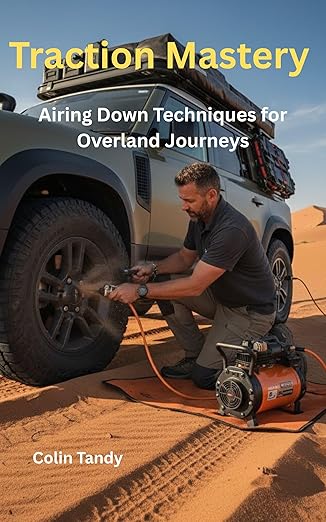
Unlock Your 4×4’s True Potential. The Most Powerful Upgrade Costs Nothing.
Go beyond guesswork with evidence-based techniques for sand, mud, rock, and snow — plus safe limits for any rig.
- Contact patch, flotation, mechanical grip — made simple.
- Terrain blueprints with starting pressures and adjustments.
- Toolkit picks and step-by-step procedures.
- Avoid de-beads, rim damage, and sidewall failures.
Authored by overlanding expert Colin Tandy. Perfect for first-time explorers and seasoned travelers alike.
© Overland Gear Guide — Tested in the field by real overlanders.